My very first Wagner performance, in person, and in Germany. It was not Bayreuth yet, but getting there, one soirée at a time.
I went into this opera with high expectations, as this was my first time experiencing Wagner live. My journey with Wagner began during an Intelligence Squared debate, Verdi vs Wagner: The 200th Birthday Debate, with Stephen Fry, where I ‘knowingly’ heard Ride of the Valkyries for the very first time. Listening with noise-canceling headphones, I was profoundly moved by the music’s power and depth, evoking in me emotions I cannot quite describe. Wagner moved me, not in any clear way however, but it was an invocation that inspired me to look for more of Wagner’s works. That piece was visceral, sweeping me away with pure sound, needing neither complicated visual interpretation nor words to land it. That was what I had hoped for with The Flying Dutchman, for the music itself to carry me, to let it unfold with its natural force, rather than relying too much on theatrical layering.
Operatic Foundations
Part of my excitement for this opera also came from the fact that I had spent a significant amount of time last year studying Wagner and learning how to appreciate opera in depth. I went through The Great Courses series with Professor Robert Greenberg, where he teaches How to Listen to and Appreciate Great Opera. I didn’t just want to skim the surface; I wanted to understand opera properly; its structure, its history, its artistic significance.
Greenberg’s course broke down the essential elements of opera: the music itself, the story and words, the staging and theatrical setting, and the performance and acting. These four elements coming together in perfect balance are what create opera as a unique and powerful art form. It is distinct from musicals, which may have some of these elements but are structured differently in terms of composition and dramatic form.
As someone who previously lived in places where opera was not easily accessible, finally being in Germany, where some of the greatest operas, particularly in the German tradition, originated, it goes without saying how I felt like I had an incredible opportunity in front of me. This was my chance to finally experience Wagner live, in his original language, in a country that shaped his work.
On the matter of Interpretation…
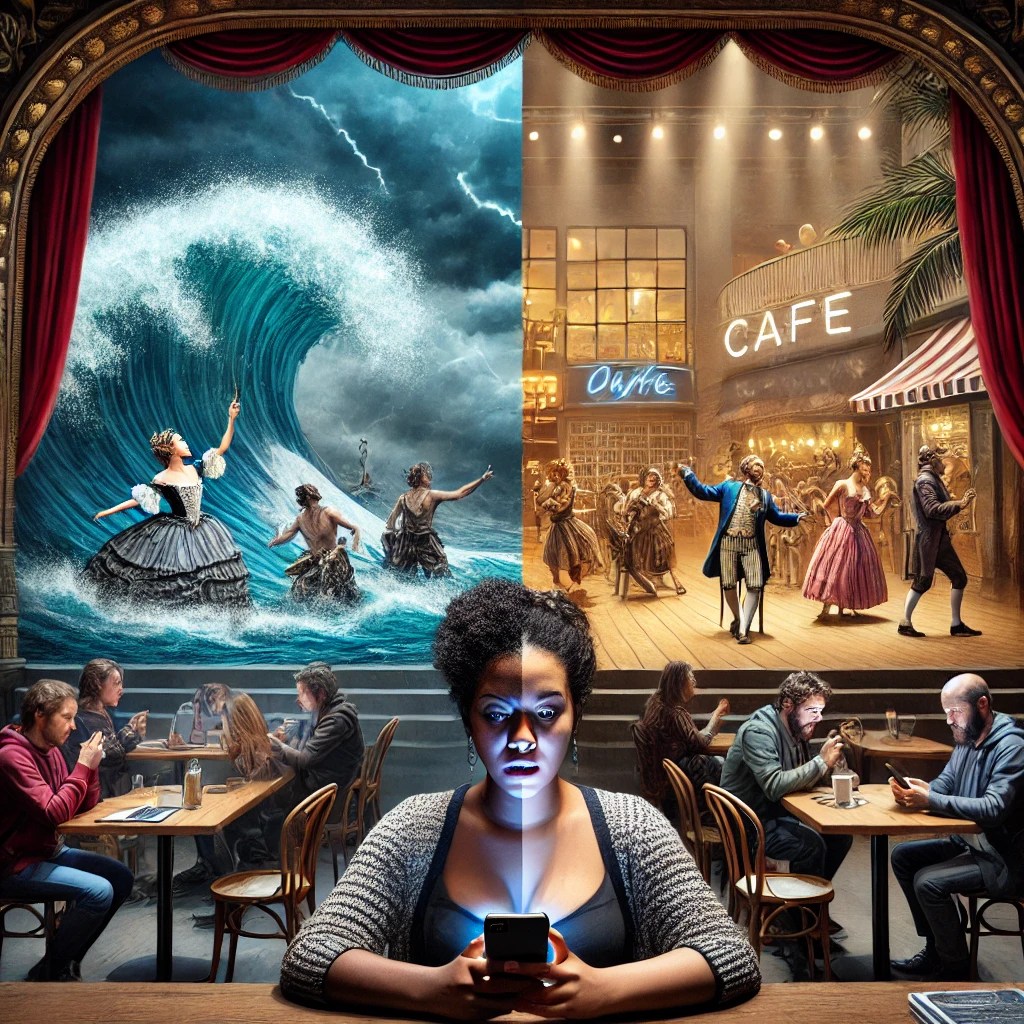
However, when I saw this Düsseldorf production, I found that the staging created a major disconnect between what I believe to be the essence of Wagner’s work and what was actually presented on stage. The modernized concept, which framed Senta’s obsession with the Dutchman through cinema and media consumption, placing key scenes in contemporary settings like a shopping mall café, and incorporating digital elements like TV screens and text messages etc., felt forced and artificial. Instead of immersing me in Wagner’s timeless, mythic world, I felt it rather distanced me from it.
One of the most jarring elements was Senta’s constant presence on stage, even during moments where she traditionally would not be. Watching the drama unfold rather than actively participating in it made her character feel somewhat passive, when Wagner’s Senta is supposed to be driven, engaged, and ultimately consumed by her obsession with the Dutchman. Maybe they meant for the constant presence on stage as the obsession expressed… somehow..? I do not know. I felt that this choice weakened the opera’s dramatic weight and made it harder for me to connect emotionally with the story.
Expectations vs. Reality
Musically, I recognized the immense power of Wagner’s composition and had high expectations for how the voices would balance with the orchestra. I noted that while the soprano (Senta) and tenor (Erik) carried well over the music, the Dutchman (a bass-baritone) often got lost in the orchestration, making it difficult to fully grasp his emotional depth. I questioned whether this imbalance was due to the performer’s vocal power or the conductor’s handling of the orchestra, or possibly just my on novice not yet fully accustomed to the work. Regardless, it contributed to my sense that the music, normally Wagner’s strongest vehicle for storytelling, was not given the clarity and impact it deserved.
At times, the production felt too busy, with the stage cluttered by distractions such as the cafés, football-watching crowds, digital projections and the like, leaving me trying to decode what was happening rather than just feeling the music as I want to believe Wagner intended. I felt that this kind of intellectualized modern interpretation is sometimes mistaken for sophistication, whereas I value the classics for what they are, not what they are reinterpreted to be. My stance is that if a work like Wagner’s The Flying Dutchman or Shakespeare’s plays are to be staged, they should be staged with respect for their original intent rather than being reshaped to fit contemporary sensibilities.
Another thing that bothered me about the production was how the leitmotifs were handled. I think I recognized the Dutchman’s motif, it features a dramatic rising octave leap, and it recurs throughout the opera. I also noticed a motif that appears in the final act, when Senta is about to give up her life and they are meant to be reunited. That moment should have carried immense dramatic weight, but I found myself distracted, trying to piece together the staging rather than fully absorbing the music. There is supposed to be a leitmotif for Senta as well, as a character, but I’m not sure I fully grasped it in this performance. Maybe it was just me not listening closely enough, but I couldn’t help but wonder if the staging pulled too much focus away from Wagner’s carefully constructed musical storytelling.
Is there too much Modernisation…?
I have been under the impression that this particular opera was meant to be a mystical experience, rooted in the supernatural, with the idea of redemption, and the unseen forces of fate weaving their hand through human lives, nature, and destiny. This is reflected in Wagner’s music, where the power of nature is conveyed through the waves, the swelling orchestration, and the dramatic musical surges that accompany the sea and the Dutchman’s curse. But in this production, it felt as though that timelessness was disrupted.
When you try too hard to modernize something ancient, classical, and beautiful, I worry that you risk stripping away the very thing that makes it compelling. It’s like taking Zeus, Athena, and the Greek gods and forcing them into a contemporary setting… at a certain point, it stops being mythology and just becomes another modern story using old names. The same is true for Shakespeare. His works endure not only because of his storytelling but because of the axioms and aphorisms embedded within his plays and sonnets; lines that remain relevant regardless of time.
Consider, “Our remedies oft in ourselves do lie, which we ascribe to heaven.” Even people who have never read Shakespeare will unknowingly quote his words, and that is precisely what makes his work timeless. When we alter these foundational pieces of art to fit modern aesthetics, we risk losing the very essence that gives them their power. And I think that, because of my study of art and literature, I have been taught to, and I firmly believe, that we must respect the different eras in which art and literature emerge. Each period brings its own unique value to an art form, and that historical context should be honored rather than forcibly reshaped to fit modern sensibilities. Putting art in context and it’s right era, allows us an appreciation much deeper than when we misplace it both in time and space. That understanding was completely lost for me in this interpretation.
Still working towards that Bayreuth experience…
Despite my disappointment with this production, my passion for Wagner remains intact… if anything, this experience has made me even more determined to seek out classical stagings that stay true to Wagner’s mythic vision. I am eager to explore traditional productions of The Flying Dutchman, whether through Bayreuth, the Royal Opera House, or other high-quality recordings, to check and if needed correct my understanding of how the opera should feel when presented without excessive modern adaptation.
Ultimately, my experience left me with mixed emotions: excitement at seeing Wagner live for the first time, frustration at the staging choices that disrupted my immersion, and a strengthened desire to seek out Wagner as Wagner, rather than Wagner forced into a contemporary framework that doesn’t feel as though it serves his music and storytelling.
 Seeking Sophie
Leave a comment